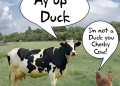
The Potteries has a voice of its own. You can hear it in the rhythm of a sentence, in shortened words and in familiar greetings passed across a market stall, a café counter or the school gate. Some expressions are especially associated with Stoke-on-Trent, while others are shared with neighbouring parts of Staffordshire, the Midlands and northern England.
This guide explains a few of the best-known examples without pretending there is one “correct” way to speak Stokie. Dialect changes between families, generations and the six towns, and written spellings are only attempts to capture sounds normally heard rather than read.
What does “Ay up, duck” mean?
“Ay up” is an informal hello or a way of attracting someone’s attention. “Duck” is a friendly term of address, much like “love”, “mate” or “dear”. Put them together and “Ay up, duck” becomes a warm, everyday greeting.
The expression is not exclusive to Stoke-on-Trent. “Duck” is also heard in other parts of the Midlands, particularly around Derbyshire and Nottinghamshire. Even so, the greeting has become part of the Potteries’ public identity and is used affectionately by local people, businesses and community groups.
“Cost kick a bo agen a wo?”
The famous Potteries tongue-twister is usually written something like:
“Cost kick a bo agen a wo, an’ yed it till it bost?”
Can you kick a ball against a wall and head it until it bursts?
There are several spellings because this is spoken dialect rather than a fixed written phrase. Broken down, cost means “can you”, bo is “ball”, agen is “against”, wo is “wall”, yed is “head”, and bost means “burst” or “break”.
It is often used as a playful test of whether somebody can produce a convincing Potteries accent. That makes it memorable, but local speech is much richer than one comic sentence.
More Potteries words and phrases
“Ow at?” or “Ow at, duck?”
This is a shortened form of “How are you?” It can be a genuine question or simply a friendly greeting. “Me duck” may be added for warmth. It does not literally mean “my lady” and can be said to people of any gender.
“Ast bin up ’Anley?”
This means “Have you been to Hanley?” The opening “h” is often left out when the phrase is written to suggest the local pronunciation. People traditionally say they are going “up Hanley”, even when a map might suggest another direction.
“Tek a wark up the cut”
In standard English, this is “Take a walk along the canal.” “Tek” represents “take”, “wark” represents “walk”, and “the cut” is an old, widely used name for a man-made canal. It feels particularly at home in the Potteries because canals once carried coal, clay and finished ware between local works and the wider country.
“Dunna”, “canna” and “wunna”
These compact forms mean “don’t”, “can’t” and “won’t”. You might hear “Dunna worry” for “Don’t worry” or “I canna do it” for “I can’t do it”. The exact sound and spelling vary, and not every local speaker uses them.
“Nesh”
If somebody is nesh, they feel the cold easily or are thought to be unusually sensitive to it. A person reaching for a coat on a mild day might be teased for being nesh. This useful old word is heard across a much wider area than Stoke, so it is regional rather than uniquely Potteries.
“Lobby”
Lobby is not a saying but an important local food word. In and around Stoke-on-Trent it usually describes a simple, warming stew made with meat, potatoes, carrots, onions and whatever else a household has to hand. Recipes differ from family to family, which is part of the tradition.

Accent, dialect and local identity
An accent describes pronunciation; a dialect also includes local vocabulary and grammar. Potteries speech contains all three. Its character has been shaped by geography, industry, migration and generations of working and living close together in the six towns.
Writing dialect can be tricky. A spelling such as “wark” or “bo” is not a claim that local people cannot spell standard English; it is simply a visual clue to pronunciation. Heavy phonetic spelling can also turn real voices into a joke, so it is worth using it with care and respect.
Local speech is not frozen in time. Younger residents may keep some words, drop others or combine them with language picked up online and from friends with different backgrounds. That change does not make the dialect less authentic. It is evidence that it is still alive.
Which Stoke saying do you use?
Do you still say “dunna”, call somebody “duck”, or know a phrase that belongs to your family or town? Tell us what it means, where you heard it and how you would spell it. Those details help preserve the story behind the words instead of treating them as a list of funny sounds.