


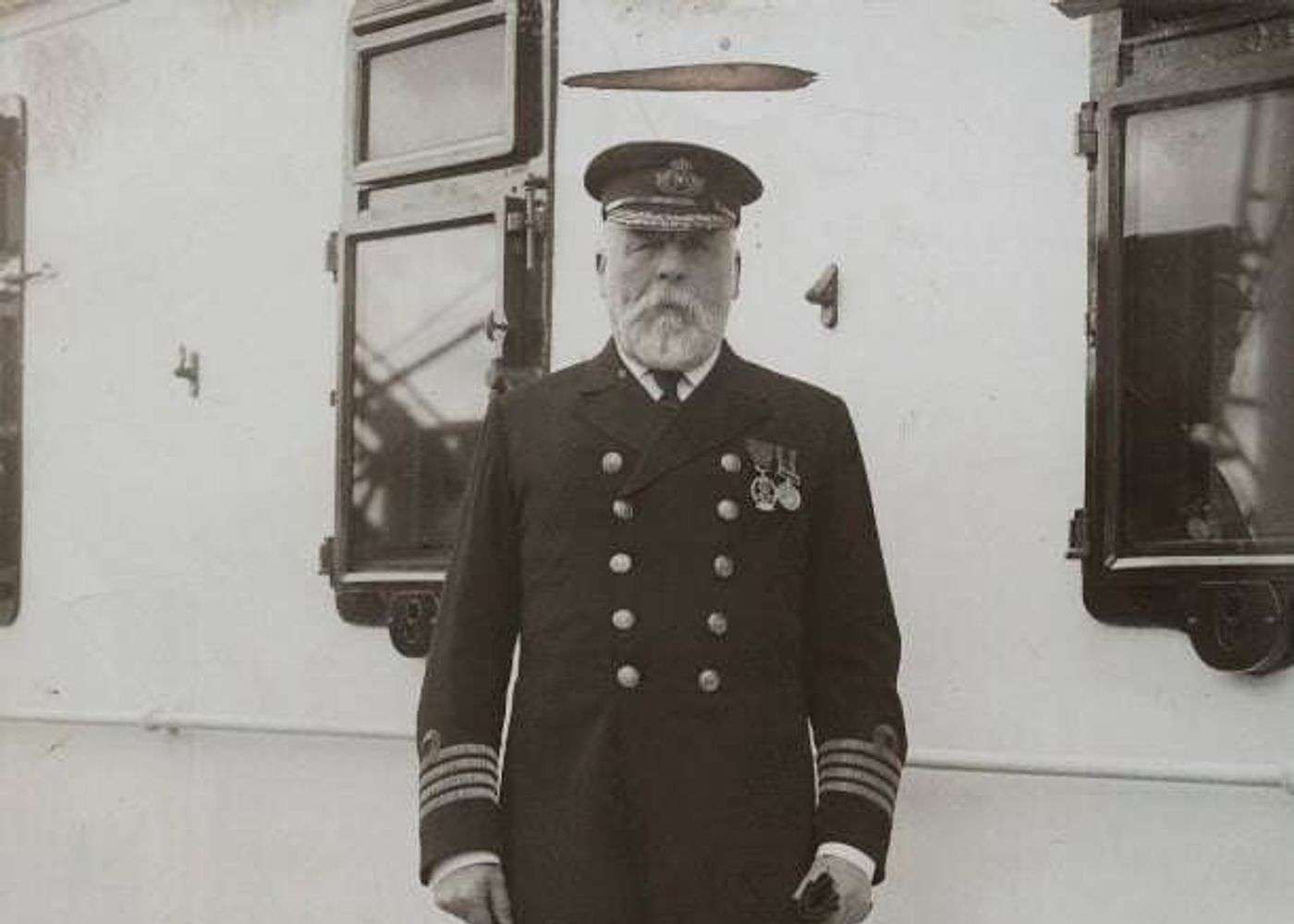
Long before Captain Edward John Smith became forever linked with the most famous maritime disaster in history, he was a Potteries lad growing up in Hanley.
Born on 27 January 1850 in Well Street, Smith came from a working-class local family. His father was a potter, and the young Edward attended the British School in Etruria before leaving formal education in his early teens.
His journey from industrial North Staffordshire to the command of the world’s most celebrated ocean liner is one of Stoke-on-Trent’s most remarkable stories.
From Etruria Forge to the open sea
After leaving school, Smith worked at the Etruria Forge, where the noise of heavy industry would have been a familiar part of everyday life. Stoke-on-Trent was expanding rapidly, powered by pottery, coal, iron and generations of skilled workers.
Smith, however, chose a very different course. At the age of 17 he travelled to Liverpool and began a maritime apprenticeship aboard the sailing ship Senator Weber.
It was a dramatic change: from the furnaces and factory streets of the Potteries to long-distance voyages across open water. Yet it marked the beginning of a seafaring career that would last roughly four decades.
Rising through the ranks
Smith earned his master’s certificate and joined the White Star Line in 1880. He steadily rose through the company, taking command of increasingly important vessels.
During his career he commanded ships including the Majestic, Baltic, Adriatic and Olympic. Titanic Belfast records that he commanded 18 vessels during his years at sea.
Smith developed a strong reputation with wealthy and experienced transatlantic travellers. His calm manner, impressive appearance and senior position helped make him one of the White Star Line’s best-known captains. He was eventually trusted with the company’s largest and most prestigious ships.
The command of RMS Titanic
In April 1912, Smith took command of RMS Titanic for her maiden voyage from Southampton to New York. At the time, she was presented as the height of modern engineering, luxury and ambition.
The ship left Southampton on 10 April and called at Cherbourg and Queenstown—now Cobh—before crossing the Atlantic.
Late on 14 April, Titanic struck an iceberg. The ship sank in the early hours of 15 April 1912, with the loss of more than 1,500 passengers and crew. Smith was among those who died, and his body was never recovered.
Accounts of his final moments differ. Over the years, witnesses and later writers have placed him on the bridge, in the water and assisting with the evacuation. With conflicting testimony and no surviving account from Smith himself, it is sensible to distinguish the established facts from the legends that grew after the disaster.
Debate, responsibility and remembrance
As captain, Smith has inevitably remained central to debates about Titanic’s speed, the response to ice warnings and the handling of the emergency. Historians continue to examine the decisions made by the officers, the White Star Line and the wider maritime industry of the period.
The disaster also led to major changes in international safety standards, including stronger lifeboat requirements, continuous radio watches and the creation of the International Ice Patrol.
For Stoke-on-Trent, Smith’s story carries a particular weight. One of the most recognisable figures in maritime history began life among the kilns, factories and terraces of Hanley.
Captain Smith’s Potteries connection
A memorial tablet was installed in Hanley Town Hall in his honour. A prominent statue was also unveiled in Lichfield in 1914, where it still stands today.
More than a century later, Smith remains one of the most internationally famous people born in Stoke-on-Trent. His name links the city to a story that continues to fascinate people around the world.
It is also a reminder of the extraordinary journeys made by local people during the industrial age. Smith began with modest roots in Hanley, left the Potteries as a teenager and eventually commanded some of the greatest liners of his era.
Did you know Captain Smith was from Hanley?
Many people know his name from Titanic, but fewer realise how closely his early life was tied to Stoke-on-Trent.
Did you already know the connection? Have you seen the memorial in Hanley Town Hall—or visited his statue in Lichfield? Let us know what other famous Stokies you would like us to feature next.
Sources and further reading: Titanic Belfast; Oxford Dictionary of National Biography; The Potteries.
Featured photograph: Captain Edward John Smith, Central Press, 1911; National Portrait Gallery, London.