


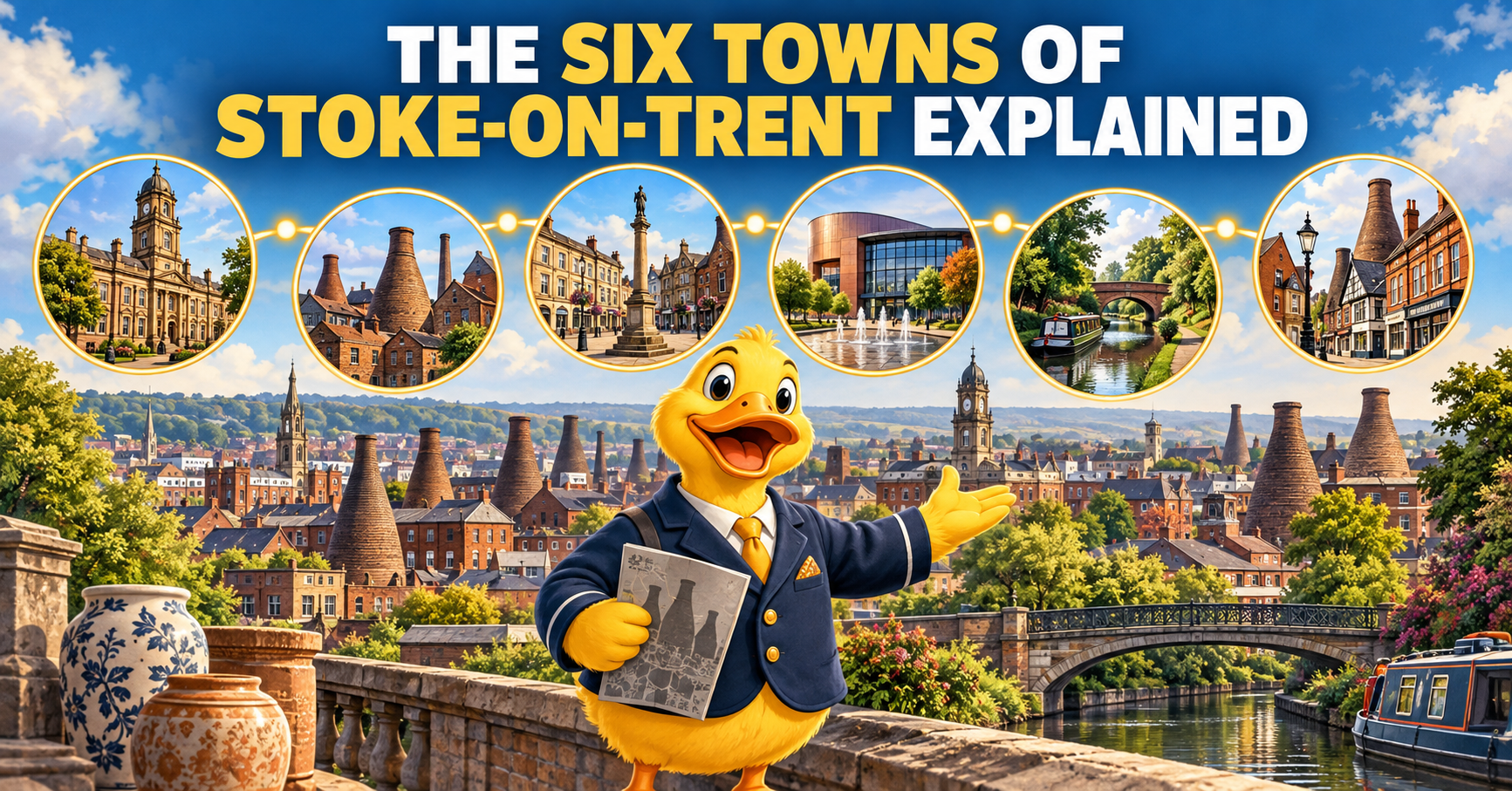
Stoke-on-Trent makes much more sense once you know that it did not grow around a single centre. The city was created from six historic pottery towns: Tunstall, Burslem, Hanley, Stoke-upon-Trent, Fenton and Longton. Each developed its own high street, public buildings, industries and loyalties before becoming part of one local authority.
That history still shapes the way the city looks and works. Hanley is generally treated as the modern city centre, while Stoke gives the city its name and contains the main railway station. Important museums, pottery sites, parks and markets are spread across the other towns. For a visitor, understanding this polycentric layout is the key to planning a good day out.
How six towns became one city
For much of the 19th century, the towns of the Potteries were separate communities linked by ceramics, coal mining, canals and a rapidly growing industrial landscape. After years of debate, the six towns federated in 1910 to form the county borough of Stoke-on-Trent. The new borough took its name from Stoke-upon-Trent, despite Hanley already being the largest commercial centre.
Stoke-on-Trent was granted city status by King George V on 5 June 1925 in recognition of its importance to the pottery industry. The administrative union did not erase the older identities. More than a century after federation, residents still commonly describe themselves by the town or neighbourhood in which they live.
Tunstall: markets and the northern Potteries
Tunstall is the northernmost of the six towns. Its centre grew around trade, ceramics and a long market tradition: records of trading on the site date back to 1525. Tunstall Market and the restored Victorian town hall remain prominent parts of the town centre, while the surrounding streets show how civic and commercial buildings developed beside the pottery industry.
Nearby Tunstall Park, also known as Victoria Park, provides a greener contrast to the town centre. Tunstall works well as a short heritage stop, particularly when combined with Burslem or Middleport. Visitors should check market days and opening arrangements before travelling, as individual traders and public buildings keep their own hours.
Burslem: the Mother Town
Burslem is traditionally known as the Mother Town of the Potteries. It was a major centre of ceramic production and is associated with figures including Josiah Wedgwood, who was born in the town and established an early pottery business there. Its surviving civic buildings, churches, former banks, factories and public houses give the centre a particularly strong historic character.
For visitors, the main attractions include the town’s architecture, independent art at Barewall, Burslem Park and nearby Middleport Pottery. Middleport is one of the clearest places to understand how a working pottery developed beside the Trent and Mersey Canal. Football supporters will also know Burslem as the home of Port Vale at Vale Park.
See our detailed guide to spending a day in Burslem.
Hanley: the modern city centre
Hanley is the city’s principal shopping, entertainment and cultural centre. This is where visitors will find The Potteries Centre, the Regent Theatre, Victoria Hall and The Potteries Museum & Art Gallery. The museum is an excellent introduction to the city because its collections connect ceramics, local history, fine art and the Staffordshire Hoard.
The Cultural Quarter is compact enough to explore on foot, and Hanley Park lies to the south between Hanley and Stoke. The park was designed in the Victorian period and has restored historic features, formal planting, sports facilities and access to the Caldon Canal.
People often use “Hanley” and “city centre” interchangeably, but Hanley is only one of the six towns. Calling the whole city Hanley misses the identities of the other five. Our Hanley day guide brings its main stops together.
Stoke-upon-Trent: the town that gave the city its name
Usually shortened simply to Stoke, Stoke-upon-Trent gave the federation its official name. It is also the main rail gateway: Stoke-on-Trent railway station stands on the edge of the town, close to the University of Staffordshire campus and within walking distance of the centre.
Stoke Minster, the town hall and the historic Spode site reflect Stoke’s civic and industrial importance. Josiah Spode’s business helped establish the town as a major ceramics centre, and parts of the former works now accommodate heritage, creative and community uses. The Trent and Mersey Canal passes nearby, reinforcing the connection between pottery production and the transport routes that carried raw materials and finished wares.
Stoke is not the main retail centre, which explains a common source of visitor confusion: arriving at Stoke-on-Trent station does not mean you have arrived in Hanley. Buses and taxis connect the station area with Hanley and the other towns.
Fenton: civic heritage between Stoke and Longton
Fenton is the smallest and often the least recognised of the six towns, but it is an essential part of the federation story. It developed through pottery, coal and ironworking, with residential streets and industrial sites growing around the town centre.
Albert Square contains some of Fenton’s most distinctive civic landmarks, including Fenton Town Hall and Christ Church. The square and surrounding streets reward visitors interested in architecture and local history, although Fenton is better treated as a focused stop than as a full tourist day. Fenton Manor Sports Complex, on the Hanley side of the town, is another familiar local landmark.
The occasional description of Fenton as the “forgotten town” says more about its lower visitor profile than its importance. Its heritage helps explain the industrial ground between Stoke, Hanley and Longton.
Longton: bottle ovens and living pottery history
Longton developed as a dense centre of pottery manufacture in the south of the city. Its skyline was once crowded with bottle ovens, and some important examples survive. The best-known visitor attraction is Gladstone Pottery Museum, a preserved former factory where workshops, yards, kilns and displays tell the story of the people and processes behind ceramics.
The town centre also includes Longton Market and a number of historic commercial and civic buildings. A short journey away, Queen’s Park—widely known as Longton Park—offers lakes, paths, trees and formal features. Together, the museum, market and park make Longton one of the easiest towns to build into a varied day.
Use our Longton day guide to plan the route.
How to explore the six towns
Trying to cover all six towns properly in one day would mean spending too much time moving between them. A better plan is to group places by area and interest:
- For museums and entertainment: begin in Hanley, then continue to Stoke if time allows.
- For pottery and canal heritage: pair Burslem with Middleport, or Stoke with the Spode site and nearby canal.
- For an industrial-history day: concentrate on Longton and Gladstone Pottery Museum.
- For markets and civic architecture: explore Tunstall, Burslem or Longton on a confirmed market day.
- For a broader first visit: choose one principal town and one nearby attraction rather than rushing through a checklist.
Distances that look short on a map are not always pleasant or practical walks, especially where major roads and former industrial land separate the town centres. Local buses connect the six towns, but routes and times can change. Drivers should check parking close to their chosen attraction, while rail visitors should remember that the station is in Stoke rather than Hanley.
Why the separate identities still matter
The six-town structure is not simply a historical curiosity. It affects transport, shopping, football loyalties, local speech and how residents describe where they come from. Each centre has faced different changes since the decline of large-scale heavy industry, and each retains buildings and stories that are easy to overlook if Stoke-on-Trent is treated as a conventional single-centre city.
For visitors, that variety is part of the appeal. Stoke-on-Trent is best understood as a collection of connected places, shaped by the same ceramic landscape but never made identical by federation.
Before you travel
Opening days, admission charges, public transport and market arrangements can change. Check individual venues and the latest information from Visit Stoke and Stoke-on-Trent City Council before making a special journey.
For more help planning a visit, read our first-time visitor’s guide and our beginner’s guide to Stoke-on-Trent’s pottery heritage.